 IST,
IST,





Content Type:
Annual Return on Foreign Liabilities and Assets (FLA) under FEMA 1999
Some Useful Definitions
Ans:
Foreign Subsidiary: An Indian entity is called as a Foreign Subsidiary if a non-resident investor owns more than 50% of the voting power/equity capital OR where a non-resident investor and its subsidiary(s) combined own more than 50% of the voting power/equity capital of an Indian enterprise.
Foreign Associate: An Indian entity is called as Foreign Associate if non-resident investor owns at least 10% and no more than 50% of the voting power/equity capital OR where non-resident investor and its subsidiary(s) combined own at least 10% but no more than 50% of the voting power/equity capital of an Indian enterprise.
Special Purpose Vehicle: A special purpose Vehicle (SPV) is a legal entity (usually a limited company of some type or, sometimes, a limited partnership) created to fulfil narrow, specific or temporary objectives. SPV have little or no employment, or operations, or physical presence in the jurisdiction in which they are created by their parent enterprises, which are typically located in other jurisdictions (economies). They are often used as devices to raise capital or to hold assets and liabilities and usually do not undertake significant production.
Domestic Deposits
III. Advances
Business restrictions imposed on Paytm Payments Bank Limited vide Press Releases dated January 31 and February 16, 2024
Money Transfer through UPI/ IMPS
Government Securities Market in India – A Primer
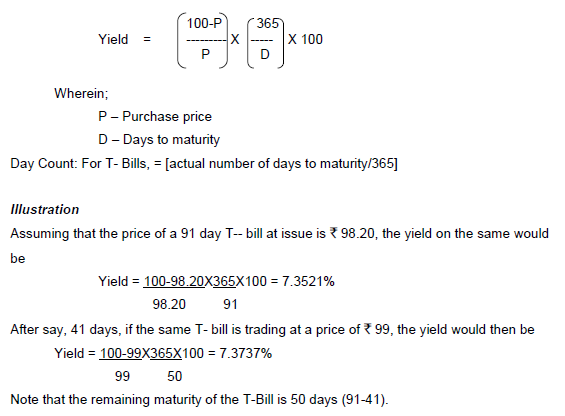
It is calculated as per the following formula
Foreign Investment in India
Indian Currency
C) Different Types of Bank Notes and Security Features of banknotes
The security features in MG Series 2005 and MG (New) Series banknotes are as under:
i. Security Thread: The silver-coloured machine-readable security thread in ₹10, ₹20 and ₹50 denomination banknotes is windowed on front side and fully embedded on reverse side. The thread fluoresces in yellow on both sides under ultraviolet light. The thread appears as a continuous line from behind when held up against light. ₹100 and above denomination banknotes have machine-readable windowed security thread with colour shift from green to blue when viewed from different angles. It fluoresces in yellow on the reverse and the text will fluoresce on the obverse under ultraviolet light.
ii. Intaglio Printing: The portrait of Mahatma Gandhi, Reserve Bank seal, Guarantee and promise clause, Ashoka Pillar emblem, RBI’s Governor's signature and the identification mark for the visually impaired persons are printed in intaglio in denominations ₹100 and above.
iii. See through register: On the left side of the note, a part of the numeral of each denomination is printed on the obverse (front) and the other part on the reverse. The accurate back-to-back registration makes the numeral appear as one when viewed against light.
iv. Water Mark and electrotype watermark: The banknotes contain the portrait of Mahatma Gandhi in the watermark window with a light and shade effect and multi-directional lines. An electrotype mark showing the denominational numeral in each denomination banknote also appears in the watermark widow and these can be viewed better when the banknote is held against light.
v. Colour Shifting Ink: The numeral 200, 500 & 2000 on the ₹200, ₹500, and ₹2000* banknotes are printed in a colour-shifting ink. The colour of these numerals appears green when the banknotes are held flat but would change to blue when the banknotes are held at an angle.
vi. Fluorescence: The number panels of the banknotes are printed in fluorescent ink. The banknotes also have dual-coloured optical fibres. Both can be seen when the banknotes are exposed to ultra-violet lamp.
vii. Latent Image: In the banknotes of ₹20 and above in the MG-2005 Series, the vertical band next to the (right side) Mahatma Gandhi’s portrait contains a latent image, showing the denominational value. The value can be seen only when the banknote is held horizontally, and light allowed to fall on it; otherwise, this feature appears only as a vertical band. In the MG (New) Series banknotes, the latent image exists in denominations ₹100 and above.
viii. Micro letterings: This feature appears at different places on the banknotes and can be seen better under a magnifying glass.
ix. Additional Features introduced since 2015:
• New Numbering Pattern
The numerals in both the number panels of the banknotes are in ascending size from left to right while the first three alpha-numeric characters (prefix) will remain constant in size.
• Angular Bleed Lines and Increase in the size of Identification Marks
Angular Bleed Lines have been introduced in banknotes - 4 lines in 2 blocks in ₹100, 4 angular bleed lines with two circles in between in ₹200, 5 lines in 3 blocks in ₹500, 7 in ₹2000*. In addition, the size of the identification marks in denominations ₹100 and above have been increased by 50 percent.
Information about the above security features present in the Indian banknotes denomination-wise is also available on the website www.rbi.org.in>>press releases. Alternately, information can also be accessed from https://website.rbi.org.in/web/rbi/-/notifications/master-circular-detection-and-impounding-of-counterfeit-notes-11610.
*₹2000 denomination notes continue to be legal tender. For more details, please refer to our press release 2023-2024/851 dated September 01, 2023 (https://rbi.org.in/web/rbi/-/press-releases/withdrawal-of-%E2%82%B92000-denomination-banknotes-status-56301).
Core Investment Companies
D. Miscellaneous:
Ans: The term used in the CIC Master Direction is block sale and not block deal which has been defined by SEBI. In the context of the Master Direction, a block sale would be a long term or strategic sale made for purposes of disinvestment or investment and not for short term trading. Unlike a block deal, there is no minimum number/value defined for the purpose.
Portfolio Investment Positions (PIP) by Counterpart Economy (formerly CPIS) – India
UPDATED: Dec 01, 2023
Special instructions for banks
Ans: Yes, it should be included.
All you wanted to know about NBFCs
D. Depositor Protection Issues
It is prescribed that the Board of Directors of NBFCs shall lay down the appropriate grievance redressal mechanism within the organisation and such mechanism shall ensure that all disputes arising out of the decisions of the lending institution’s functionaries are heard and disposed of at least at the next higher level.
Further, NBFCs (excluding Housing Finance Companies) which are authorised to accept deposits; or have customer interface and an asset size of ₹100 crore & above as on the date of the last audited balance sheet, are covered under Reserve Bank - Integrated Ombudsman Scheme, 2021 (as amended from time to time). In case of grievances against NBFCs, which are covered under RBI Ombudsman Scheme, are not redressed within a period of one month, the customer may approach the Ombudsman through its CMS portal accessible on the link https://cms.rbi.org.in/cms/indexpage.html#eng.
Domestic Deposits
III. Advances
An illustrative list of Intermediary Agencies is as under;
-
State Sponsored organizations for on-lending to Weaker Sections@
-
Distributors of agricultural inputs/ implements.
-
State Financial Corporations (SFCs)/ State Industrial Development Corporations (SIDCs) to the extent they provide credit to weaker sections.
-
National Small Industries Corporation (NSIC).
-
Khadi and Village Industries Commission (KVIC)
-
Agencies involved in assisting the decentralized sector.
-
Housing and Urban Development Corporation Ltd. (HUDCO)
-
Housing Finance Companies approved by National Housing Bank (NHB) for refinance.
-
State sponsored organization for SCs/STs (for purchase and supply of inputs to and/or marketing of output of the beneficiaries of these organizations).
-
Micro Finance Institutions/ Non-Government Organizations (NGOs) on lending to SHGs.
@ ‘Weaker Sections’ in Priority Sector includes following:
-
Small and marginal farmers with land holdings of 5 acres and less, landless labourers, tenant farmers and share-croppers;
-
Artisans, village and cottage industries where individual credit requirements do not exceed Rs.25,000/-.
-
Small and marginal farmers, sharecroppers, agricultural and non-agricultural labourers, rural artisans and families living below the poverty lines are the beneficiaries. The family income should not exceed Rs.11,000/- per annum.
-
Scheduled Castes and Scheduled Tribes.
-
Beneficiaries are persons whose family income from all sources does not exceed Rs.7200/- per annum in urban or semi urban areas or Rs.6400/- per annum in rural areas. They should not own any land or the size of their holding does not exceed one acre in the case of irrigated land and 2.5 acres in the case of unirrigated land (land holding criteria do not apply to SC/ST).
-
Beneficiaries under Scheme of Liberation and Rehabilitation of Scavengers (SLRs).
-
Advances granted to Self-Help Groups (SHGs) for reaching the rural poor.
FAQs on Non-Banking Financial Companies
Time frame for compliance of regulations
Retail Direct Scheme
Investment and Account holdings related queries
G-Secs are credit risk free instruments in domestic currency. However, there are market risks if you sell before maturity. You may refer to ‘Government Securities Market- A primer’, published on RBI website, to understand various risks associated with government securities.
Annual Return on Foreign Liabilities and Assets (FLA) under FEMA 1999
Some Useful Definitions
Ans: Participating preference shares are those shares which have one or more of the following rights:
(a) To receive dividend, out of surplus profit after paying the dividend to equity shareholders.
(b) To have share in surplus assets remaining after the entire capital is paid in case of winding up of the company.
On the other hand, non-participating preference shares are those shares which do not have any of the above said rights.
Business restrictions imposed on Paytm Payments Bank Limited vide Press Releases dated January 31 and February 16, 2024
Paytm Payments Bank Business Correspondent
Government Securities Market in India – A Primer
27.1 Duration (also known as Macaulay Duration) of a bond is a measure of the time taken to recover the initial investment in present value terms. In simplest form, duration refers to the payback period of a bond to break even, i.e., the time taken for a bond to repay its own purchase price. Duration is expressed in number of years. A step by step approach for working out duration is given in the Box IV below.
| Calculation for Duration First, each of the future cash flows is discounted to its respective present value for each period. Since the coupons are paid out every six months, a single period is equal to six months and a bond with two years maturity will have four time periods. Second, the present values of future cash flows are multiplied with their respective time periods (these are the weights). That is the PV of the first coupon is multiplied by 1, PV of second coupon by 2 and so on. Third, the above weighted PVs of all cash flows is added and the sum is divided by the current price (total of the PVs in step 1) of the bond. The resultant value is the duration in no. of periods. Since one period equals to six months, to get the duration in no. of year, divide it by two. This is the time period within which the bond is expected to pay back its own value if held till maturity. Illustration: Taking a bond having 2 years maturity, and 10% coupon, and current price of ₹101.79, the cash flows will be (prevailing 2 year yield being 9%):
Duration in number of periods = 379.28/101.79 = 3.73 Duration in years = 3.73/2 = 1.86 years |
More formally, duration refers to:
-
The weighted average term (time from now to payment) of a bond's cash flows or of any series of linked cash flows.
-
The higher the coupon rate of a bond, the shorter the duration (if the term of the bond is kept constant).
-
Duration is always less than or equal to the overall life (to maturity) of the bond.
-
Only a zero coupon bond (a bond with no coupons) will have duration equal to its maturity.
What is Modified Duration?
27.2 Modified duration (MD) is a modified version of Macaulay Duration. It refers to the change in value of the security to one per cent change in interest rates (Yield). The formula is
Illustration
In the above example given in Box IV, MD = 1.86/(1+0.09/2) = 1.78
Duration is useful primarily as a measure of the sensitivity of a bond's market price to interest rate (i.e., yield) movements. It is approximately equal to the percentage change in price for one percent change in yield. For example the duration is the approximate percentage by which the value of the bond will fall for a 1% per annum increase in market interest rate. So, a 15-year bond with a duration of 7 years would fall approximately 7% in value if the interest rate increased by 1% per annum. In other words, duration is the elasticity of the bond's price with respect to interest rates. This ignores convexity explained in para 24.7
What is PV 01?
27.3 PV01 describes the actual change in price of a bond if the yield changes by one basis point (equal to one hundredth of a percentage point). It is the present value impact of 1 basis point (0.01%) (1%=100 bps) movement in interest rate. It is often used as a price alternative to duration (a time measure). Higher the PV01, the higher would be the volatility (sensitivity of price to change in yield).
Illustration
From the modified duration (given in the illustration under 27.2), we know that the security value will change by 1.78% for a change of 100 basis point (1%) change in the yield. In value terms that is equal to 1.78*(101.79/100) = ₹ 1.81.
Hence the PV01 = 1.81/100 = ₹0.018, which is 1.8 paise. Thus, if the yield of a bond with a Modified Duration of 1.78 years moves from say 9% to 9.05% (5 basis points), the price of the bond moves from ₹101.79 to ₹101.70 (reduction of 9 paise, i.e., 5x1.8 paise).
What is Convexity?
27.4 Calculation of change in price for change in yields based on duration works only for small changes in yields. This is because the relationship between bond price and yield is not strictly linear. Over large variations in yields, the relationship is curvilinear i.e., the reduction in option free bond price is less than the change calculated based only on duration for yield increase, and increase in option free bond price will be more than the change calculated based only on duration for yield decrease. This is measured by a concept called convexity, which is the change in duration of a bond due to change in the yield of the bond.
Foreign Investment in India
Indian Currency
C) Different Types of Bank Notes and Security Features of banknotes
In addition to the security features listed above, banknotes issued after introduction of MG series-2005 have the year of printing on the reverse of the banknotes which is not present in the pre-2005 series.
Core Investment Companies
D. Miscellaneous:
Ans: Adjusted net worth (ANW) is a concept akin to capital requirement wherein the ANW should not be less than 30% of the risk weighted assets (RWA). In cases where asset size is aggregated, all the CICs within the group will be registered as CIC and ANW will be applicable individually.
Portfolio Investment Positions (PIP) by Counterpart Economy (formerly CPIS) – India
UPDATED: Dec 01, 2023
Special instructions for banks
Ans: No, it should not be included, as it will be considered as resident-to-resident transaction.
All you wanted to know about NBFCs
D. Depositor Protection Issues
The Reserve Bank has issued detailed regulations on deposit acceptance, including the quantum of deposits that can be collected, mandatory credit rating, mandatory maintenance of liquid assets for repayment to depositors, manner of maintenance of its deposit books, prudential regulations including maintenance of adequate capital, limitations on exposures, and inspection of the NBFCs, besides others, to ensure that the NBFCs function on sound lines. If the Reserve Bank observes through its inspection or audit of any NBFC or through complaints or through market intelligence, that a certain NBFC is not complying with the Reserve Bank’s directions, it may prohibit the NBFC from accepting further deposits and prohibit it from selling its assets. In addition, if the depositor has complained to the Company Law Board (CLB) [now National Company Law Tribunal (NCLT)] which has ordered repayment and the NBFC has not complied with the CLB/NCLT order, the Reserve Bank can initiate prosecution of the NBFC, including criminal action and winding up of the NBFC.
More importantly, the Reserve Bank initiates prompt action, including imposing penalties and taking legal action against companies which are found to be violating its instructions/norms on the basis of Market Intelligence reports, complaints, exception reports from statutory auditors of the companies, information received through SLCC meetings, etc. The Reserve Bank immediately shares such information with all the financial sector regulators and enforcement agencies in the State Level Coordination Committee Meetings.
As part of its public policy measure, the Reserve Bank has been in the forefront in taking several initiatives to create awareness among the general public on the need to be careful while investing their hard earned money. The initiatives include issue of cautionary notices in print media and distribution of informative and educative brochures/pamphlets and close interaction with the public during awareness/outreach programs, Townhall events, participation in State Government sponsored trade fairs and exhibitions. At times, it even requests newspapers with large circulation (English and vernacular) to desist from accepting advertisements from unincorporated entities seeking deposits. The Reserve Bank has also launched its public awareness initiative with the tag line ‘RBI Kehta Hai’ which may be accessed at https://rbi.org.in/web/rbi/rbi-kehta-hai.
Annual Return on Foreign Liabilities and Assets (FLA) under FEMA 1999
Some Useful Definitions
Ans: If the Indian entity has issued the shares to non-resident entities under the FDI scheme in India, then it is a FDI and should be reported under the Foreign Direct Investment in India (Liabilities) of the return.
FAQs on Non-Banking Financial Companies
Credit Rating
- The NBFCs in the category of equipment leasing and hire purchase finance companies having Rating of less than the Investment Grade as mentioned below are no longer entitled to accept fresh public deposits :
Name of rating agencies | Level of minimum investment |
EL/HP Cos. | LC/ICs |
CRISIL | A- (A MINUS) |
ICRA | A- (A MINUS) |
CARE | BBB (FD) |
DCR India | BBB- (BBB minus) |
The Loan and Investment Companies having Rating of less than `A are no longer entitled to accept fresh deposits.
It may be added that A- is not equivalent to A; AA- is not equivalent to AA and AAA- is not equivalent to AAA.
Retail Direct Scheme
Investment and Account holdings related queries
The returns on Government securities are dependent on various features of the securities. You may refer to ‘Government Securities Market- A primer’, published on RBI website, to understand the factors affecting the returns on government securities.
Domestic Deposits
III. Advances
Yes. The banks are free to determine the rates of interest without reference to BPLR and regardless of the size, in respect of following loans:
(i) a. Loans for purchase of consumer durables.
b. Loans to individuals against shares and debentures/ bonds
c. Other non-priority sector personal loans.
d. Advances/ overdrafts against domestic/ NRE/ FCNR(B) deposits with the bank, provided that the deposit/s stands/ stand either in the name(s) of the borrower himself/ borrowers themselves, or in the names of the borrower jointly with another person.
e. Finance granted to intermediary agencies (excluding those of housing) for on lending to ultimate beneficiaries and agencies providing input support.
f. Finance granted to housing finance intermediary agencies for on lending to ultimate beneficiaries
g. Discounting of Bills
h. Loans/Advances/Cash Credit/Overdrafts against commodities subject to Selective Credit Control
ii. Loans covered by participation in interest refinancing schemes of term lending institutions. | Banks are free to charge rates as per stipulations of the refinancing agencies without reference to BPLR |
Business restrictions imposed on Paytm Payments Bank Limited vide Press Releases dated January 31 and February 16, 2024
Accounts frozen, lien marked etc.
Any lien or freeze (full or partial) marked as per the instructions of any law enforcement or judicial authorities on the account/wallet of a customer with Paytm Payments Bank will continue to be governed by the orders passed by such authorities
Government Securities Market in India – A Primer
28.1 For Cooperative banks, investments classified under 'Held to Maturity' (HTM) category need not be marked to market and will be carried at acquisition cost unless it is more than the face value, in which case the premium should be amortized over the period remaining to maturity. The individual scrip in the ‘Available for Sale’ (AFS) category in the books of the cooperative banks will be marked to market at the year-end or at more frequent intervals. The individual scrip in the ‘Held for Trading’ (HFT) category will be marked to market at monthly or at more frequent intervals. The book value of individual securities in AFS and HFT categories would not undergo any change after marking to market.
28.2 RBI vide FMRD.DIRD.7/14.03.025/2017-18 dated March 31, 2018 has notified that Financial Benchmark India Pvt. Ltd (FBIL) has been advised to assume the responsibility for administering valuation of Government securities with effect from March 31, 2018. From this date, FIMMDA has ceased to publish prices/yield of Government securities and this role has been taken over by FBIL. FBIL had commenced publication of the G-Sec and SDL valuation benchmarks based on the extant methodology. Going forward, FBIL will undertake a comprehensive review of the valuation methodology. RBI regulated entities, including banks, non-bank financial companies, Primary Dealers, Co-Operative banks and All India Financial Institutions who are required to value Government securities using prices published by FIMMDA as per previous directions may use FBIL prices with effect from March 31, 2018. Other market participants who have been using Govt. securities prices/yields published by FIMMDA may use the prices/yields published by FBIL for valuation of their investment portfolio.
28.3 State Development Loans were previously valued by applying YTM method by marking it up by a spread of 25 basis points on the Central G-Sec yield of the corresponding residual maturity, whereas for corporate bonds the spreads given by the FIMMDA need to be added. RBI vide its notification DBR.BP.BC.No.002 /21.04.141/2018-19 dated July 27, 2018 decided that securities issued by each state government, i.e., State Development Loans (SDLs), shall be valued in a manner which would objectively reflect their fair value based on observed prices/yields and Financial Benchmarks India Pvt. Ltd. (FBIL) shall make available prices for valuation of SDLs based on the above principles. Brief details of valuation methodology is provided in Box V.
| A framework in this regard has been formulated by FBIL having the following elements: (a) On any business day, the secondary market prices/YTM of SDLs and the auction prices/YTM of SDLs, as available, will be used for their valuation. However, the secondary market trades that are referred to the Dispute Resolution Committee (DRC) of the Fixed Income Money Market and Derivatives Association of India (FIMMDA) and the reversed trades when they occur, will be excluded, (b) Interpolation/ extrapolation technique will be used in respect of the remaining SDLs which do not trade on that day, and (c) Consistency/market alignment check, as applicable, will be applied in respect of all traded prices/YTM. The methodology seeks to strike a judicious and prudent balance between two opposing considerations: Since the number of actual/observed prices in respect of SDLs are very small, the opportunity cost of not including any actual/observed price is high (consequence of the so-called Type 1 error). However, sufficient care has been exercised, by way of the imposition of a set of objective criteria, to make sure that (i) off-market data are excluded, and (ii) no incentive for market manipulation is provided (reducing the possibility of the so called Type 2 error). The detailed valuation methodology along with illustrations is provided on FBIL website at link https://www.fbil.org.in/uploads/general/FBIL-SDL_Valuation_Methodology.pdf |
28.4 In the case of corporate bonds, the spread that need to be added to the corresponding yield on central G-Sec will be published by the FIMMDA from time to time. FIMMDA gives out the information on corporate bond spreads for various ratings of bonds. While valuing a bond, the appropriate spread has to be added to the corresponding CG yield and the bond has to be valued using the standard ‘Price’ formula.
Foreign Investment in India
Indian Currency
C) Different Types of Bank Notes and Security Features of banknotes
The Mahatma Gandhi (New) Series banknotes have a sharp colour contrast scheme to facilitate identification by the partially visually challenged. The banknotes from ₹100 denomination onwards, have angular bleed lines (4 lines in 2 blocks in ₹100, 4 angular bleed lines with two circles in between in ₹200, 5 lines in 3 blocks in ₹500, 7 in ₹2000*) and identification mark for the benefit of the visually challenged. There is an identification mark on the front side of each note which is in raised print (intaglio) and has different shapes for different denominations for e.g. Horizontal rectangle for ₹2000, circle for ₹500, raised Identification mark H for ₹200, triangle for ₹100. Further, in these denominations, numerals are prominently displayed in the central area of the notes in raised print.
*₹2000 denomination notes continue to be legal tender. For more details, please refer to our press release 2023-2024/851 dated September 01, 2023 (https://rbi.org.in/web/rbi/-/press-releases/withdrawal-of-%E2%82%B92000-denomination-banknotes-status-56301).
Core Investment Companies
D. Miscellaneous:
Ans: The total assets of all NBFCs (Including Standalone Primary Dealer (SPD), Infrastructure Debt Fund-Non-Banking Financial Company (IDF-NBFC) and NBFCs which will always remain in Base Layer, viz., NBFC-Peer to Peer Lending Platform (NBFC-P2P), NBFC-Account Aggregator (NBFC-AA), Non-Operative Financial Holding Company (NOFHC) and NBFC without public funds and customer interface) in a Group, including all the registered Core Investment Companies (CICs) and unregistered CICs with asset size less than ₹100 crore which have raised public funds, shall be consolidated to determine the threshold for classification of other group NBFCs (NBFC- Investment and Credit Company (NBFC-ICC), NBFC- Micro Finance Institution (NBFC-MFI), NBFC- Factor and NBFC- Mortgage Guarantee Company (NBFC-MGC)) into middle layer. However, the consolidation of asset of unregistered CICs for the above purpose would not change the status of unregistered CICs.
All you wanted to know about NBFCs
D. Depositor Protection Issues
The purpose of enacting this law is to protect the interests of the depositors. The provisions of RBI Act are directed towards enabling RBI to issue prudential regulations that make the financial entities function on sound lines. RBI is a civil body and the RBI Act is a civil Act. Both do not have specific provisions to effect recovery by attachment and sale of assets of the defaulting companies, entities or their officials. It is the State government machinery which can effectively do this. The Protection of Interest of Depositors in Financial Establishments Acts, confers adequate powers on the State Governments to attach and sell assets of the defaulting companies, entities and their officials.
FAQs on Non-Banking Financial Companies
Credit Rating
Domestic Deposits
III. Advances
Annual Return on Foreign Liabilities and Assets (FLA) under FEMA 1999
Some Useful Definitions
Ans: Under FLA return, calculation of market value of equity capital for unlisted companies is done using the Own Funds at Book Value (OFVB) method, in accordance with IMF’s guidelines under the compilation of CDIS data for a country. It is calculated as follows:
Market value of equity capital held by Non- resident at OFBV for current year/previous year
= (Net worth of the company for current year/previous year) * (% non-resident equity holding for current year/previous year)
where, Net worth of the company
= (Paid up Equity & Participating Preference share capital of company + Reserves & Surplus - Accumulated losses)
Retail Direct Scheme
Investment and Account holdings related queries
| S. No. | Government security | Minimum investment amount/quantity (as on Nov 12, 2021) |
| 1 | Government of India Treasury Bills (T-Bills) | ₹10,000 |
| 2 | Government of India dated securities (dated G-Sec) | ₹10,000 |
| 3 | State Development Loans (SDLs) | ₹10,000 |
| 4 | Sovereign Gold Bonds (SGB) | One gram of gold |
Business restrictions imposed on Paytm Payments Bank Limited vide Press Releases dated January 31 and February 16, 2024
Accounts frozen, lien marked etc.
The bank has been directed to allow withdrawal or transfer to another bank account of the customer, upto the available balance in the account / wallets.
Government Securities Market in India – A Primer
G-Secs are generally referred to as risk free instruments as sovereigns rarely default on their payments. However, as is the case with any financial instrument, there are risks associated with holding the G-Secs. Hence, it is important to identify and understand such risks and take appropriate measures for mitigation of the same. The following are the major risks associated with holding G-Secs:
29.1 Market risk – Market risk arises out of adverse movement of prices of the securities due to changes in interest rates. This will result in valuation losses on marking to market or realizing a loss if the securities are sold at adverse prices. Small investors, to some extent, can mitigate market risk by holding the bonds till maturity so that they can realize the yield at which the securities were actually bought.
29.2 Reinvestment risk – Cash flows on a G-Sec includes a coupon every half year and repayment of principal at maturity. These cash flows need to be reinvested whenever they are paid. Hence there is a risk that the investor may not be able to reinvest these proceeds at yield prevalent at the time of making investment due to decrease in interest rates prevailing at the time of receipt of cash flows by investors.
29.3 Liquidity risk – Liquidity in G-Secs is referred to as the ease with which security can be bought and sold i.e. availability of buy-sell quotes with narrow spreads. Liquidity risk refers to the inability of an investor to liquidate (sell) his holdings due to non-availability of buyers for the security, i.e., no trading activity in that particular security or circumstances resulting in distressed sale (selling at a much lower price than its holding cost) causing loss to the seller. Usually, when a liquid bond of fixed maturity is bought, its tenor gets reduced due to time decay. For example, a 10-year security will become 8 year security after 2 years due to which it may become illiquid. The bonds also become illiquid when there are no frequent reissuances by the issuer (RBI) in those bonds. Bonds are generally reissued till a sizeable amount becomes outstanding under that bond. However, issuer and sovereign have to ensure that there is no excess burden on Government at the time of maturity of the bond as very large amount maturing on a single day may affect the fiscal position of Government. Hence, reissuances for securities are generally stopped after outstanding under that bond touches a particular limit. Due to illiquidity, the investor may need to sell at adverse prices in case of urgent funds requirement. However, in such cases, eligible investors can participate in market repo and borrow the money against the collateral of such securities.
Risk Mitigation
29.4 Holding securities till maturity could be a strategy through which one could avoid market risk. Rebalancing the portfolio wherein the securities are sold once they become short term and new securities of longer tenor are bought could be followed to manage the portfolio risk. However, rebalancing involves transaction and other costs and hence needs to be used judiciously. Market risk and reinvestment risk could also be managed through Asset Liability Management (ALM) by matching the cash flows with liabilities. ALM could also be undertaken by matching the duration of the assets and liabilities.
Advanced risk management techniques involve use of derivatives like Interest Rate Swaps (IRS) through which the nature of cash flows could be altered. However, these are complex instruments requiring advanced level of expertise for proper understanding. Adequate caution, therefore, need to be observed for undertaking the derivatives transactions and such transactions should be undertaken only after having complete understanding of the associated risks and complexities.
Foreign Investment in India
Indian Currency
C) Different Types of Bank Notes and Security Features of banknotes
Mobile Aided Note Identifier (MANI) is a mobile application launched by the Reserve Bank for aiding visually impaired persons to identify the denomination of Indian Banknotes. The free of cost application, once installed, does not require internet and is capable of identifying the denominations of Mahatma Gandhi Series and Mahatma Gandhi (New) series banknote by checking front or reverse side/part of the note including half folded notes at various holding angles and in a broad range of light conditions (normal light/day light/low light etc).
Note: This mobile application does not authenticate a note as being either genuine or counterfeit.
Core Investment Companies
D. Miscellaneous:
Ans: Yes. As per the present directions for CICs, they are permitted to make investments in money market instruments, including money market mutual funds. Since Liquid Funds are also mutual funds with the underlying being money market instruments; CICs are permitted to invest their surplus funds in Liquid Fund Schemes also.
All you wanted to know about NBFCs
D. Depositor Protection Issues
Yes, to a large extent. The Act makes offences, such as, unauthorized acceptance of deposits by any entity, firm or company a cognizable offence, that is entities that are indulging in unauthorized deposit acceptance or unlawful financial activities can be immediately imprisoned and prosecuted. Under the Act, the State Governments have been given vast powers to attach the property of such entities, dispose them off under the orders of special courts and distribute the proceeds to the depositors. The widespread State Government / State Police machinery is best positioned to take quick action against the culprits.
Further, Government of India has recently enacted the Banning of Unregulated Deposit Schemes Act, 2019, a Central Legislation, which provides a comprehensive mechanism to ban the unregulated deposit schemes, other than deposits taken in ordinary course of business, and to protect the interest of depositors. This Act has specific provisions for restitution of depositors through various means viz., attachment and sale of property, etc. This Act also provides for enhanced legislative mechanism for handling unregulated deposit schemes viz., constitution of Designated Courts to deal with matters under the Act, powers for investigation (including by Central Bureau of Investigation in case deposits, deposit-takers and properties are located in more than one State or Union Territory, or outside India), search & seizure, penal provisions, etc.
FAQs on Non-Banking Financial Companies
Credit Rating
Domestic Deposits
III. Advances
Annual Return on Foreign Liabilities and Assets (FLA) under FEMA 1999
Some Useful Definitions
Ans: If the Indian reporting entity is listed, then their closing share price as on reference period, i.e., end-March of previous and current year is used for valuation of non-resident equity investment.
Retail Direct Scheme
Investment and Account holdings related queries
For dated G-Sec, T-Bills and SDLs – The following limits apply if you purchase these securities through the non-competitive segment of primary auctions:
| S. No. | Government security | Maximum investment amount/quantity (as on Nov 12, 2021) |
| 1 | Government of India Treasury Bills (T-Bills) | The aggregate allocation of all non-competitive bids will be restricted to a maximum of 5% of the aggregate nominal amount of the issue within the notified amount as specified by the Government of India, or any other percentage determined by RBI. |
| 2 | Government of India dated securities (dated G-Sec) | ₹2 crore (face value) per security per auction. |
| 3 | State Development Loans (SDLs) | 1% of notified amount (face value) per auction |
For Sovereign Gold Bonds (SGBs) – An individual may not subscribe to more than 4 kg of SGBs per fiscal year. The annual ceiling will include bonds subscribed under different tranches during initial issuance by Government and those purchased from the Secondary Market.
Business restrictions imposed on Paytm Payments Bank Limited vide Press Releases dated January 31 and February 16, 2024
Onboarding of new customers
The business restriction dated March 11, 2022, prohibiting Paytm Payments Bank from onboarding any new customers for any of its services continues to be in force. Hence, Paytm Payments Bank cannot onboard any new customers after March 11, 2022.
Government Securities Market in India – A Primer
30.1 While the G-Secs market generally caters to the investors with a long-term investment horizon, the money market provides investment avenues of short term tenor. Money market transactions are generally used for funding the transactions in other markets including G-Secs market and meeting short term liquidity mismatches. By definition, money market is for a maximum tenor of one year. Within the one year, depending upon the tenors, money market is classified into:
i. Overnight market - The tenor of transactions is one working day.
ii. Notice money market – The tenor of the transactions is from 2 days to 14 days.
iii. Term money market – The tenor of the transactions is from 15 days to one year.
What are the different money market instruments?
30.2 Money market instruments include call money, repos, T- Bills (for details refer para 1.3), Cash Management Bills (for details refer para 1.4), Commercial Paper, Certificate of Deposit and Collateralized Borrowing and Lending Obligations (CBLO).
Call money market
30.3 Call money market is a market for uncollateralized lending and borrowing of funds. This market is predominantly overnight and is open for participation only to scheduled commercial banks and the primary dealers.
Repo market
30.4 Repo or ready forward contact is an instrument for borrowing funds by selling securities with an agreement to repurchase the said securities on a mutually agreed future date at an agreed price which includes interest for the funds borrowed.
30.5 The reverse of the repo transaction is called ‘reverse repo’ which is lending of funds against buying of securities with an agreement to resell the said securities on a mutually agreed future date at an agreed price which includes interest for the funds lent.
30.6 It can be seen from the definition above that there are two legs to the same transaction in a repo/ reverse repo. The duration between the two legs is called the ‘repo period’. Predominantly, repos are undertaken on overnight basis, i.e., for one day period. Settlement of repo transactions happens along with the outright trades in G-Secs.
30.7 The consideration amount in the first leg of the repo transactions is the amount borrowed by the seller of the security. On this, interest at the agreed ‘repo rate’ is calculated and paid along with the consideration amount of the second leg of the transaction when the borrower buys back the security. The overall effect of the repo transaction would be borrowing of funds backed by the collateral of G-Secs.
30.8 The repo market is regulated by the Reserve Bank of India. All the above mentioned repo market transactions should be traded/reported on the electronic platform called the Clearcorp Repo Order Matching System (CROMS).
30.9 As part of the measures to develop the corporate debt market, RBI has permitted select entities (scheduled commercial banks excluding RRBs and LABs, PDs, all-India FIs, NBFCs, mutual funds, housing finance companies, insurance companies) to undertake repo in corporate debt securities. This is similar to repo in G-Secs except that corporate debt securities are used as collateral for borrowing funds. Only listed corporate debt securities that are rated ‘AA’ or above by the rating agencies are eligible to be used for repo. Commercial paper, certificate of deposit, non-convertible debentures of original maturity less than one year are not eligible for this purpose. These transactions take place in the OTC market and are required to be reported on FIMMDA platform within 15 minutes of the trade for dissemination of trade information. They are also to be reported on the clearing house of any of the exchanges for the purpose of clearing and settlement.
Triparty Repo
"Tri-party repo" means a repo contract where a third entity (apart from the borrower and lender), called a Tri-Party Agent, acts as an intermediary between the two parties to the repo to facilitate services like collateral selection, payment and settlement, custody and management during the life of the transaction. Funds borrowed under repo including tri-party repo in government securities shall be exempted from CRR/SLR computation and the security acquired under repo shall be eligible for SLR provided the security is primarily eligible for SLR as per the provisions of the Act under which it is required to be maintained.
Tri Party Repo Dealing System (TREPS) facilitates, borrowing and lending of funds, in Triparty Repo arrangement. CCIL is the Central Counterparty to all trades from TREPS and also perform the role and responsibilities of Triparty Repo Agent. All the repo eligible entities are entitled to participate in Triparty Repo. The entity type admitted include, Public Sector Banks, Private Banks, Foreign Banks, Co-operative Banks, Financial Institutions, Insurance Companies, Mutual Funds, Primary Dealers, Bank cum Primary Dealers, NBFCs, Corporates, Provident/ Pension Funds, Payment Banks, Small Finance Banks, etc.
TREPS Dealing System is an anonymous order matching System provided by CCDS (Clearcorp Dealing Systems (India) Ltd) to enable Members to borrow and lend funds. It also disseminates online information regarding deals concluded, volumes, rate etc., and such other notifications as relevant to borrowing and lending under Triparty Repo by the members. The borrowing and/ or lending can be done for settlement type T+0 and T+1.
Commercial Paper (CP)
30.13 Commercial Paper (CP) is an unsecured money market instrument issued in the form of a promissory note and held in a dematerialized form through any of the depositories approved by and registered with SEBI. A CP is issued in minimum denomination of ₹5 lakh and multiples thereof and shall be issued at a discount to face value No issuer shall have the issue of CP underwritten or co-accepted and options (call/put) are not permitted on a CP. Companies, including NBFCs and AIFIs, other entities like co-operative societies, government entities, trusts, limited liability partnerships and any other body corporate having presence in India with net worth of ₹100 cr or higher and any other entities specifically permitted by RBI are eligible to issue Commercial papers subject to conditions specified by RBI. All residents, and non-residents permitted to invest in CPs under Foreign Exchange Management Act (FEMA), 1999 are eligible to invest in CPs; however, no person can invest in CPs issued by related parties either in the primary or secondary market. Investment by regulated financial sector entities will be subject to such conditions as the concerned regulator may impose.
RBI has issued Reserve Bank Commercial Paper Directions 2017 - FMRD.DIRD.01/CGM (TRS) - 2017 dated August 10, 2017
Certificate of Deposit (CD)
30.14 Certificate of Deposit (CD) is a negotiable money market instrument and issued in dematerialised form or as a Usance Promissory Note, for funds deposited at a bank or other eligible financial institution for a specified time period. Banks can issue CDs for maturities from 7 days to one year whereas eligible FIs can issue for maturities from 1 year to 3 years.
Foreign Investment in India
Indian Currency
C) Different Types of Bank Notes and Security Features of banknotes
The processes and systems followed for production of Indian banknotes are at par with the best practices adopted globally. In line with the same, banknote quality is maintained well within the various tolerance parameters for dimension, placement of design, print features etc. A press release issued by RBI in this regard can be accessed at the following link: https://rbi.org.in/web/rbi/-/press-releases/rbi-clarifies-on-quality-control-measures-in-currency-note-printing-41364.
Core Investment Companies
D. Miscellaneous:
Yes, activities such as trading or rendering services to the group companies are not restricted for CICs, provided such activities are carried out purely in the nature of a non-financial activity, and they do not lead the CIC to carry on any other financial activity not permitted under the extant instructions within the group or on behalf of the group entities. Such activities should not ultimately render creation of any financial asset which the CICs are not permitted to hold within/outside the group. Further, CICs cannot enter into commodity derivative contracts or hold any non-financial assets other than real estate or other fixed assets which are required for effective functioning of the CIC outside the group within the limit of 10% of net assets.
All you wanted to know about NBFCs
D. Depositor Protection Issues
The Reserve Bank is strengthening its market intelligence function and is constantly examining the financials of companies, references for which are received through market intelligence or complaints to the Reserve Bank. As part of initiative of State Level Consultation Committee comprising of Regulators and Government, the Sachet portal (https://sachet.rbi.org.in/) has been launched and members of public are requested to share any relevant information pertaining to unauthorised collection of deposits. In this, context, members of public can contribute a great deal by being vigilant and lodging a complaint immediately if they come across any financial entity that contravenes the RBI Act. For example, if they are accepting deposits unauthorisedly and/conducting NBFC activities without obtaining due permission from the Reserve Bank. More importantly, these entities will not be able to function if members of public start investing wisely. Members of the public must know that high returns on investments will also have high risks. And there can be no assured return for speculative activities. Before investing, the public must ensure that the entity they are investing in is a regulated entity with one of the financial sector regulators.
FAQs on Non-Banking Financial Companies
Credit Rating
Annual Return on Foreign Liabilities and Assets (FLA) under FEMA 1999
Some Useful Definitions
Ans: A related party is a person or entity that is related to the entity that is preparing its financial statements (referred to as the ‘reporting entity’).
A person or a close member of that person’s family is related to a reporting entity if that person:
(i) has control or joint control over the reporting entity.
(ii) has significant influence over the reporting entity; or
(iii) is a member of the key management personnel of the reporting entity or of a parent of the reporting entity.
In the definition of a related party, an associate includes subsidiaries of the associate and a joint venture includes subsidiaries of the joint venture. Therefore, for example, an associate’s subsidiary and the investor that has significant influence over the associate are related to each other.
Retail Direct Scheme
Investment and Account holdings related queries
There are two ways to buy Government securities through Retail Direct platform:
-
By placing a bid in the primary auctions of dated G-Sec, T-Bills and SDLs (Non-competitive segment only, i.e., by only entering the desired amount of securities, without entering a price). For Sovereign Gold Bonds (SGBs), you may place a bid during the subscription windows announced by RBI on its website. For step-by-step details on bidding in auctions, you may refer to the User Manual on the Retail Direct Portal.
-
By placing a buy quote in the secondary market portal.
Domestic Deposits
III. Advances
Government Securities Market in India – A Primer
31.1 The Fixed Income Money Market and Derivatives Association of India (FIMMDA), an association of Scheduled Commercial Banks, Public Financial Institutions, Primary Dealers and Insurance Companies was incorporated as a Company under section 25 of the Companies Act,1956 on June 3, 1998. FIMMDA is a voluntary market body for the bond, money and derivatives markets. FIMMDA has members representing all major institutional segments of the market. The membership includes Nationalized Banks such as State Bank of India, its associate banks and other nationalized banks; Private sector banks such as ICICI Bank, HDFC Bank; Foreign Banks such as Bank of America, Citibank, Financial institutions such as IDFC, EXIM Bank, NABARD, Insurance Companies like Life Insurance Corporation of India (LIC), ICICI Prudential Life Insurance Company, Birla Sun Life Insurance Company and all Primary Dealers.
31.2 FIMMDA represents market participants and aids the development of the bond, money and derivatives markets. It acts as an interface with the regulators on various issues that impact the functioning of these markets. FIMMDA also plays a constructive role in the evolution of best market practices by its members so that the market as a whole operates transparently as well as efficiently.
31.3 Financial Benchmarks India Pvt. Ltd (FBIL) was incorporated in 2014 as per the recommendations of the Committee on Financial Benchmarks. FBIL has taken over existing benchmarks such as Mumbai Inter-Bank Outright Rate (MIBOR) and option volatility and introduced new benchmarks such as Market Repo Overnight Rate (MROR), Certificate of Deposits (CDs) and T-Bills yield curves. The development of FBIL as an independent organisation for administration of all financial market benchmarks including valuation benchmarks is important for the credibility of these benchmarks and integrity of financial markets. FBIL has assumed the responsibility for administering valuation of Government securities with effect from March 31, 2018.
FBIL has also assumed the responsibility for computation and dissemination of the daily “Reference Rate” for Spot USD/INR and other major currencies against the Rupee, which was previously being done by the Reserve Bank.
Foreign Investment in India
Answer: Downstream investment made in accordance with the guidelines in existence prior to February 13, 2009 would not require any modification to conform to these regulations. All other investments, after the said date, would come under the ambit of FEMA 20(R). Downstream investments made between February 13, 2009 and June 21, 2013 which were not in conformity with these regulations should have been intimated to the Reserve Bank by October 3, 2013, for treating such cases as compliant with these regulations.
Indian Currency
D) Soiled, Mutilated and Imperfect Banknotes
(i) A ‘soiled note’ means a note which has become dirty due to normal wear and tear and includes a two-piece note pasted together wherein both the pieces presented belong to the same note and form the entire note with no essential feature missing.
(ii) “Mutilated banknote” is a banknote, of which a portion is missing, or which is composed of more than two pieces.
(iii) “Imperfect banknote” means any banknote, which is wholly or partially, obliterated, shrunk, washed, altered or indecipherable but does not include a mutilated banknote.
Core Investment Companies
D. Miscellaneous:
The number of layers of CICs within a Group (including the parent CIC) shall be restricted to two, irrespective of the extent of direct or indirect holding/ control exercised by a CIC in the other CIC. For instance, if a group consists of a parent CIC namely HCo which is holding 100 per cent equity capital in three other CICs namely A, B and C, the layers in the group shall be as follows.
- HCo shall be considered as first layer of CIC
- A,B and C shall be considered as second layer of CICs.
- Any cross holdings, directly or indirectly through other entities in the group, by CICs in the second layer in any other CIC in the group shall be considered as creation of third layer of CIC/s in the group structure which is a violation of the extant instructions. However, investment by second layer CICs in non-CIC group companies is not a violation to the extant CIC regulations. Further, no restriction is placed on number of CICs in a horizontal layer.
All you wanted to know about NBFCs
E. Collective Investment Schemes (CIS) and Chit Funds
No. CIS are schemes where money is exchanged for units, be it profits, income, produce, property etc. Collective Investment Schemes (CIS) do not fall under the regulatory purview of the Reserve Bank and falls under the regulatory purview of SEBI. Information on such schemes and grievances against the promoters may be immediately forwarded to SEBI as well as to the EOW/Police Department of the State Government.
Indian Currency
D) Soiled, Mutilated and Imperfect Banknotes
Reserve Bank of India has been continuously making efforts to make good quality banknotes available to the members of public. To help RBI and the banking system towards this objective, the members of public are requested to ensure the following:
-
Not to staple the banknotes;
-
Not to write/put rubber stamp or any other mark on the banknotes;
-
Not to use banknotes for making garlands/toys, decorating pandals and places of worship or for showering on personalities in social events, etc.
The Reserve Bank of India has issued a press release on March 12, 2008, appealing members of public not to use banknotes for making garlands, decorating pandals and places of worship or for showering on personalities in social events, etc. Press Release issued in this regard is available at the following link:
https://rbi.org.in/web/rbi/-/press-releases/respect-your-banknotes-rbi-appeals-to-public-18026.
FAQs on Non-Banking Financial Companies
Credit Rating
Retail Direct Scheme
Investment and Account holdings related queries
Annual Return on Foreign Liabilities and Assets (FLA) under FEMA 1999
Some Useful Definitions
Ans: Any domestic liabilities or assets (even if it is in foreign currency) should not be reported in the FLA return.
Domestic Deposits
III. Advances
Government Securities Market in India – A Primer
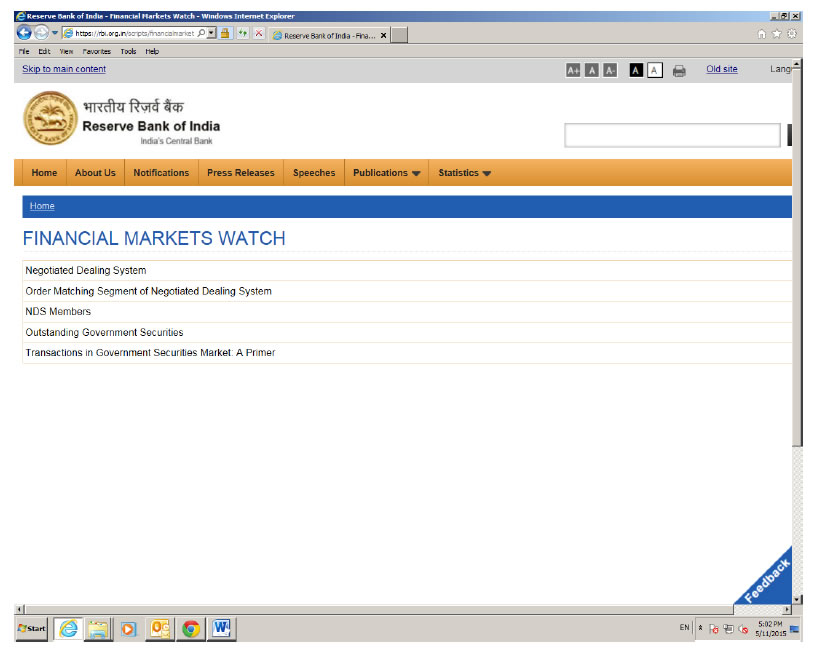
32.1. RBI financial market watch - /en/web/rbi/financial-markets/other-links/financial-market-watch
This site provides links to information on prices of G-Secs on NDS-OM, money market and other information on G-Secs like outstanding stock etc.
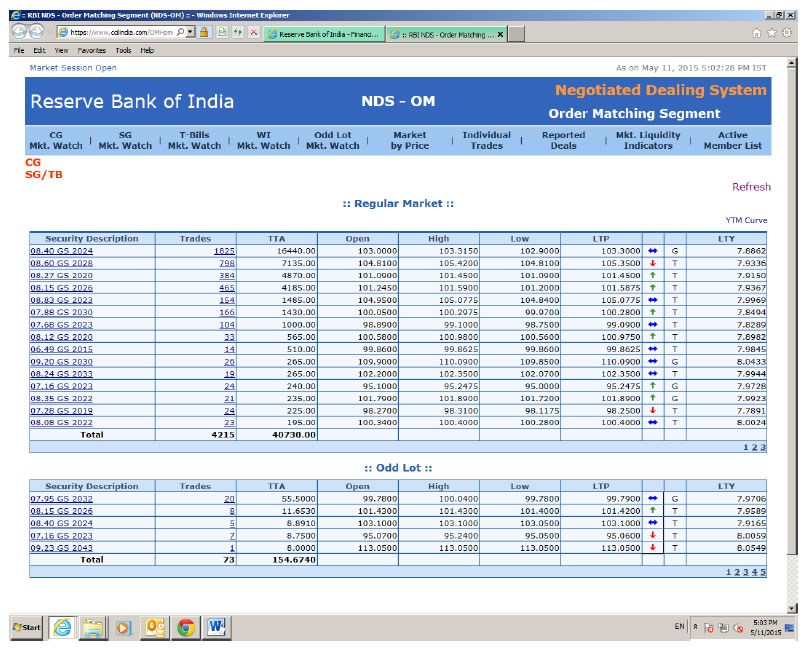
32.2. NDS-OM market watch https://www.ccilindia.com/OMHome.aspx
This site provides real-time information on traded as well as quoted prices of G-Secs, both in Order matching and Reporting segment. In addition, prices of When Issued (WI) (whenever trading takes place) segment are also provided.
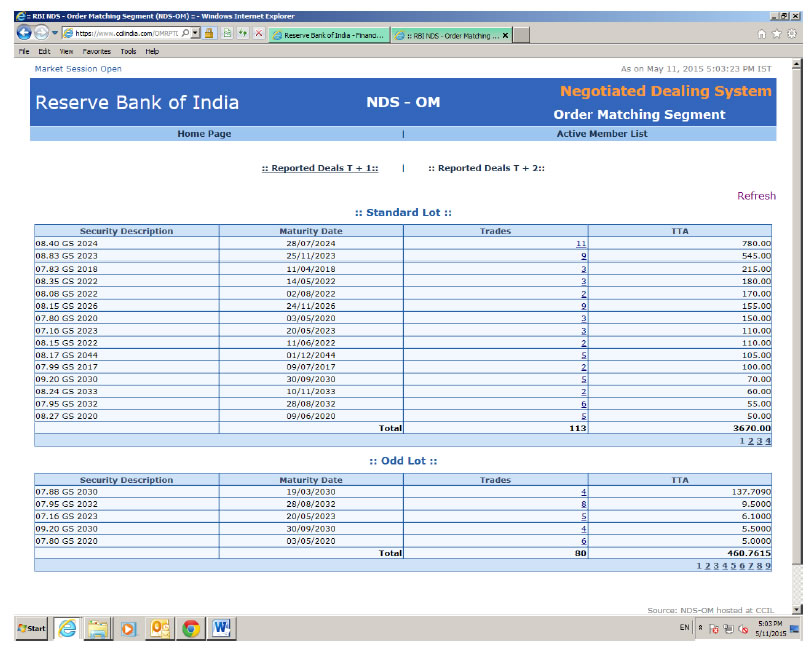
32.3. Reported deals on NDS-OM: https://www.ccilindia.com/OMRPTDeals.aspx
This site provides information on prices of G-Secs in OTC market as reported. One can see chronological traded price levels and quantity in various securities.
32.4 FBIL – www.fbil.org.in
Financial Benchmark India Private Ltd (FBIL) was jointly promoted by Fixed Income Money Market & Derivative Association of India (FIMMDA), Foreign Exchange Dealers’ Association of India (FEDAI) and Indian Banks’ ‘Association (IBA). It was incorporated on 9th December 2014 under the Companies Act 2013. It was recognised by Reserve bank of India as an independent Benchmark administrator on 2nd July 2015.
The company is run by a Board of Directors, assisted by an oversight committee. The main object of the company is to act as the administrators of the Indian interest rate and foreign exchange benchmarks and to introduce and implement policies and procedures to handle the benchmarks. It also will make policies for possible cessation of any benchmark and to follow steps for ensuring orderly transition to the new benchmarks. FBIL will review each benchmark to ensure that the benchmarks accurately represent the economic realities of the interest that it intends to measure. It will take up/consider such other benchmarks as may be required from time to time by periodically assessing the emerging needs of the end -users.
32.5 FIMMDA - http://www.fimmda.org/
This site provides a host of information on market practices for all the fixed income securities including G-Secs. Accessing information from this site requires a valid login and password which are provided by FIMMDA to the eligible entities.
Foreign Investment in India
Indian Currency
D) Soiled, Mutilated and Imperfect Banknotes
Yes. Such banknotes can be exchanged for value.
All you wanted to know about NBFCs
E. Collective Investment Schemes (CIS) and Chit Funds
Retail Direct Scheme
Investment and Account holdings related queries
-
After logging into the Primary Market Retail Direct platform, select the ‘Primary Market’ option beside the Dashboard, at the top of the page.
-
Select a security to bid from the ‘Auction Watch’ and enter the bid amount in the ‘Bid Entry’ window.
-
Individuals can fund their bid either at the time of bidding or at a later time, but before the closure of bidding/subscription window. Bids which are not funded as on the date of submission of bids to RBI will be cancelled.
-
For making payment for the bids, retail clients can use services like UPI (Transfer or Block) and Net Banking to transfer funds to a designated current account using Payment Gateways linked to the Online Portal.
-
Based on the allotment advice received as a part of the auction result, the allotments will be made to the individual investors.
-
In case of full allotment, each bidder will be allocated the entire Face Value for which bids were submitted. In case of partial allotment, a pro-rata allotment will be made to the bidder based on the partial allocation percentage determined in the auction.
For further details on the biding process, you may refer to the User Manual in the Help section of the Retail Direct Portal.
FAQs on Non-Banking Financial Companies
Credit Rating
Annual Return on Foreign Liabilities and Assets (FLA) under FEMA 1999
Some Useful Definitions
Ans: If the reporting Indian company invests in equity and/or participating preference shares of overseas company, under the Overseas Direct Investment Scheme in India, i.e. investment in Joint venture or wholly owned subsidiaries abroad, then it is considered as direct investment abroad of the Indian company.
NOTE: Registration guidelines and section-wise FAQs for further guidance to be file the FLA return are available in the FAQs section of the FLAIR portal (https://flair.rbi.org.in/fla/faces/pages/login.xhtml).
Domestic Deposits
III. Advances
Government Securities Market in India – A Primer
Foreign Investment in India
Indian Currency
D) Soiled, Mutilated and Imperfect Banknotes
All banks are authorized to accept and exchange soiled banknotes for full value. They shall extend the facility of exchange of soiled/mutilated notes to non-customers also.
All branches of commercial banks are authorised to adjudicate mutilated banknotes (which are legal tender) and pay value for these, in terms of the Reserve Bank of India (Note Refund) Rules, 2009 [as amended by Reserve Bank of India (Note Refund) Amendment Rules, 2018].
Small Finance Banks (up to two years from the commencement of their banking business) and Payment Banks may exchange mutilated and imperfect/defective notes at their option.
All you wanted to know about NBFCs
F. Money Circulation/Multi-Level Marketing (MLM)/ Ponzi Schemes/ Unincorporated Bodies (UIBs)
No, Multi-Level Marketing companies, Direct Selling Companies, Online Selling Companies do not fall under the purview of the Reserve Bank. Activities of these companies fall under the regulatory/administrative domain of respective state government. The provisions of the Consumer Protection Act, 2019 and the Consumer Protection (Direct Selling) Rules, 2021 may be referred. The list of regulators and the entities regulated by them are provided in Annex I.
FAQs on Non-Banking Financial Companies
Credit Rating
Retail Direct Scheme
Investment and Account holdings related queries
Domestic Deposits
III. Advances
Government Securities Market in India – A Primer
List of Primary Dealers (As on April 01, 2020)
| STANDALONE PRIMARY DEALERS | BANK PRIMARY DEALERS |
| ICICI Securities Primary Dealership Limited ICICI Centre H.T.Parekh Marg Churchgate Mumbai- 400 020 Phone: (022) 22882460/70, 66377421 | Bank of America, N.A. One BKC, ‘A’ Wing ‘G’ Block, Bandra Kurla Complex Bandra (E), Mumbai – 400 051 Phone: 022-66323111 |
| Morgan Stanley India Primary Dealer Pvt. Ltd. 18F / 19F One Indiabulls Centre Tower 2, Jupiter Mills Compound Elphinstone Road Mumbai - 400013 Phone : (022) 61181000 Fax : (022) 61181011 | Bank Of Baroda Specialised Integrated Treasury 4th & 5th Floor, Baroda Sun Tower, C-34, G-Block, Bandra Kurla Complex Bandra East, Mumbai-400 051 Phone:(022) 66363636 / 67592705 |
| Nomura Fixed Income Securities Pvt. Ltd. Ceejay House, 11th Level Plot F, Shivsagar Estate Dr.Annie Besant Road Worli Mumbai - 400 018 Phone : (022) 40374037 Fax : (022) 40374111 | Canara Bank Domestic Back Office Integrated Treasury Wing VI Floor, Canara Bank Building C-14, G Block, Bandra Kurla Complex Bandra East Mumbai- 400 051 Phone: (022) 26725126, 123 |
| PNB Gilts Ltd. 5, Sansad Marg New Delhi- 110 001 Phone: Mumbai - (022) 22693315/17 New Delhi - (011) 23325751,22693315/17 | Citibank N.A FIFC, 12th floor, C-54 and 55, G block, Bandra Kurla Complex, Mumbai – 400 051. Phone:(022) 6175 7187 |
| SBI DFHI Ltd 3rd Floor, Voltas House, 23, J.N.Heredia Marg, Ballard Estate, Mumbai- 400 001 Phone:(022) 22625970/73, 22610490, 66364696 | Union Bank of India |
| STCI Primary Dealer Limited Marathon Innova, Marathon Nextgen Compound, Off Ganpatrao Kadam Marg, Lower Parel(W), Mumbai- 400 013 Phone:(022) 30031100, 66202261/2200 | HDFC Bank Ltd. Treasury Mid Office, 1st Floor,HDFC Bank House Senapati Bapat Marg, Lower Parel Mumbai- 400 013 Phone:(022) 24904702/4935/3899, 66521372/9892975232 |
| Goldman Sachs (India) Capital Markets Pvt. Ltd. 951-A, Rational House, Appasaheb Marathe Marg, Prabhadevi, Mumbai 400 025 Phone : (022) 66169000 | Hongkong and Shanghai Banking Corpn. Ltd.(HSBC) Treasury Services 52/60, Mahatma Gandhi Road Mumbai- 400 001 Phone:(022) 22681031/34/33, 22623329/22681031/34/38 |
| J P Morgan Chase Bank N.A, Mumbai Branch J.P. Morgan Tower Off C.S.T. Road, Kalina Santacruz (East) Mumbai - 400 098 Phone -61573000 Fax- 61573990 & 61573916 | |
| Kotak Mahindra Bank Ltd. 27BKC, 5th Floor Plot No. C-27, G-Block Bandra Kurla Complex Bandra East Mumbai 400 051. Phone:(022) 6659 6022/6454, 66596235/6454 | |
| Standard Chartered Bank Financial Markets Financial Market Operation Crescenzo, 5th Floor Plot no. C-38 & 39, G – Block Bandra Kurla Complex Mumbai – 400 051 Phone : (022) 61158893 | |
| Axis Bank Ltd. Treasury Operations Corporate Office, 4th Floor, Axis House Bombay Dyeing Compound Pandurang Budhkar Marg Worli, Mumbai - 400 025 Phone- (022) 24254430, 24254434 Fax- (022) 24252400 / 5400 | |
| IDBI Bank Limited IDBI Tower, Cuffe Parade Mumbai- 400 005 Phone- (022) 66263351 | |
| Deutsche Bank AG C-70, G Block, Bandra Kurla Complex Mumbai-400051 Phone: (022) 71804444 | |
| Yes Bank Limited Yes Bank Tower, IFC 2, Elphinstone (W), Senapati Bapat Marg, Mumbai-400013 Phone: (022) 33669000 |
* Bank PDs are those which take up PD business departmentally as part of the bank itself.
** Stand alone PDs are Non Banking Financial Companies (NBFCs) that exclusively take up PD business.
Update to the list of Primary dealers is available on the RBI website at /en/web/rbi/citizen-corner/primary-dealers
Foreign Investment in India
Indian Currency
D) Soiled, Mutilated and Imperfect Banknotes
The value of an imperfect note may be paid for full value/half value under rules as specified in Part III of Reserve Bank of India (Note Refund) Rules, 2009 [As amended by Reserve Bank of India (Note Refund) Amendment Rules, 2018] available in our website under www.rbi.org.in → Publications → Occasional.
All you wanted to know about NBFCs
F. Money Circulation/Multi-Level Marketing (MLM)/ Ponzi Schemes/ Unincorporated Bodies (UIBs)
While some of these terms are not formally defined, generally, the money circulation, multi-level marketing / chain marketing or Ponzi schemes are schemes promising easy or quick money upon enrollment of members. Income under multi-level marketing or pyramid structured schemes do not come from the sale of products they offer as much as from enrolling more and more members from whom hefty subscription fees are taken. It is incumbent upon all members to enroll more members, as a portion of the subscription amounts so collected is distributed among the members at the top of the pyramid. Any break in the chain leads to the collapse of the pyramid, and the members lower in the pyramid are the ones that are affected the most. Ponzi schemes are those schemes that collect money from the public on promises of high returns. As there is no asset creation, money collected from one depositor is paid as returns to the other. Since there is no other activity generating returns, the scheme becomes unviable and impossible for the people running the scheme to meet the promised return or even return the principal amounts collected. The scheme inevitably fails, and the perpetrators disappear with the money.
FAQs on Non-Banking Financial Companies
Credit Rating
Retail Direct Scheme
Investment and Account holdings related queries
For dated G-Sec, T-Bills and SDLs, the amount per unit will be based on the indicative price of the security, the accrued interest and a mark-up.
For SGBs, the funding will be based on the Issue Price declared by RBI for that particular issue.
Domestic Deposits
III. Advances
Government Securities Market in India – A Primer
Foreign Investment in India
II. Foreign Portfolio Investment
Indian Currency
D) Soiled, Mutilated and Imperfect Banknotes
The details are available on our website at the following link: www.rbi.org.in >> Currency Management >>Notifications.
A summary of the old (2009) and amended NRR (2018) is as under:
Note Refund Rules - Amended
| Sr. No. | As per Old NRR (2009) | As per Amended NRR (2018) |
| 1 | Notes up to ₹20 denominations i) area of single largest undivided piece of the note > 50% - Full value ii) area of largest undivided piece of the note =/< 50% - Reject |
No change |
| 2 | Notes of ₹50/- and above denominations i) If area is less than 40% - Reject ii) If the area is equal to or more than 40% and less than or equal to 65% - Half value iii) If the area of the single largest undivided pieces is more than 65% - Full value |
Notes of ₹50/- & above denominations i) If area is less than 40% - Reject ii) If the area is more than or equal to 40% and less than or equal to 80% - Half value iii) If the area of the single largest undivided pieces is more than 80% - Full value |
All you wanted to know about NBFCs
F. Money Circulation/Multi-Level Marketing (MLM)/ Ponzi Schemes/ Unincorporated Bodies (UIBs)
No. Acceptance of money under Money Circulation Schemes, by whatever name called, is not allowed as acceptance of money under those schemes is a cognizable offence under the Prize Chit and Money Circulation (Banning) Act, 1978, and are banned. The Reserve Bank has no role in implementation of this Act, except advising and assisting the Central Government in framing the Rules under this Act.
FAQs on Non-Banking Financial Companies
Liquid Asset requirement
Domestic Deposits
III. Advances
Retail Direct Scheme
Investment and Account holdings related queries
Government Securities Market in India – A Primer
Foreign Investment in India
III. Investment in other securities
Answer: Foreign Portfolio Investors (FPIs), Non-Resident Indians (NRIs), Overseas Citizens of India (OCIs), Foreign Central Banks, Multilateral Development Bank, Long term investors like Sovereign Wealth Funds (SWFs), Multilateral Agencies, Endowment Funds, Insurance Funds and Pension Funds which are registered with SEBI Long Term Investors may invest in other securities as specified in Schedule 5 to Notification No FEMA 20.
Indian Currency
D) Soiled, Mutilated and Imperfect Banknotes
Non-payable banknotes are retained by the receiving banks and sent to the Reserve Bank where they are destroyed.
All you wanted to know about NBFCs
F. Money Circulation/Multi-Level Marketing (MLM)/ Ponzi Schemes/ Unincorporated Bodies (UIBs)
Any information/grievance relating to such schemes should be given to the police / Economic Offence Wing (EOW) of the concerned State Government or the Ministry of Corporate Affairs. If brought to the notice of the Reserve Bank, the same shall be informed to the concerned State Government authorities.
FAQs on Non-Banking Financial Companies
Liquid Asset requirement
Retail Direct Scheme
Investment and Account holdings related queries
Install the RBI mobile application and get quick access to the latest news!
Scan the QR code to install our app



Page Last Updated on: December 10, 2022


