 IST,
IST,





Content Type:
Business restrictions imposed on Paytm Payments Bank Limited vide Press Releases dated January 31 and February 16, 2024
Paytm Payments Bank Wallet
Government Securities Market in India – A Primer
Foreign Investment in India
Indian Currency
B) Banknotes
The paper currently being used for printing of banknotes in India is made by using 100% cotton.
Biennial survey on Foreign Collaboration in Indian Industry (FCS)
Some important definitions and concepts
Ans.: An Indian company is called as a Foreign Subsidiary if a non-resident investor owns more than 50 per cent of the voting power / equity capital or where a non-resident investor and its subsidiary(s) combined own more than 50 per of the voting power / equity capital of an Indian enterprise.
Core Investment Companies
B. Registration and related matters:
Ans: The NBFC would have to apply to RBI with full details of the plan and exemptions could be considered on a selective basis on the merits of the case.
Portfolio Investment Positions (PIP) by Counterpart Economy (formerly CPIS) – India
What to report under PIP?
Ans: Reporting entities should report the data in the unit mentioned in the survey schedule (for eg., INR Lakh).
Remittances [Money Transfer Service Scheme (MTSS) and Rupee Drawing Arrangement (RDA)]
Money Transfer Service Scheme (MTSS)
All you wanted to know about NBFCs
B. Entities Regulated by RBI and applicable regulations
Reserve Bank of India has deregulated interest rates to be charged to borrowers by NBFCs. The rate of interest to be charged by the company is governed by the terms and conditions of the loan agreement entered into between the borrower and the NBFCs. However, the NBFCs have to be transparent and the rate of interest and manner of arriving at the rate of interest to different categories of borrowers should be disclosed to the borrower or customer in the application form and communicated explicitly in the sanction letter and on their websites, Key Facts Statement, etc., to enable the borrower to take an informed decision.
Housing Loans
When other banks reduce the interest rate, you may prefer to close your account with the bank with whom you are banking, to avail of the loan from the bank offering reduced rates of interest. You have to pay pre-payment charges for doing so. In order to ensure that their customers do not approach other banks for availing reduced interest rates, banks allow customers to switch over from a higher interest loan to a lower interest loan by paying a switch over fees which is lesser than the pre-payment charges. Generally switchover fee is taken as percentage of the outstanding loan amount.
Keep up-dating yourself on various changes in the home loan market. Visit the branch, discuss with the officials to get the best out of any changes in the home loan scenario.
Targeted Long Term Repo Operations (TLTROs)
FAQs pertaining to TLTRO 2.0
Ans: The funds availed under TLTRO 2.0 are to be deployed in investment grade bonds, commercial paper (CPs) and non-convertible debentures (NCDs) of Non-Banking Financial Companies (NBFCs) and MFIs in the manner outlined in the press release dated April 17, 2020.
FAQs on Non-Banking Financial Companies
Ceiling on deposits
A. As per the new Regulatory framework, there is no overall ceiling on the borrowings of NBFCs. However, limits have been prescribed for acceptance of Public Deposits as indicated here.
Level of credit rating | Ceiling on public deposits | |
EL/HP Cos. | LC/ICs | |
AAA | 4.0 | 2.0 |
AA | 2.5 | 1.0 |
A | 1.5 | 0.5 |
A - (CRISIL & ICRA) } | ||
BBB (CARE) } | 0.5 | Nil |
BBB- (DCR India) } | ||
It is to be noted that there is an in-built ceiling on the total borrowings of the NBFCs accepting deposits from public, because they are required to maintain a capital adequacy ratio of 10 per cent of their risk weighted assets effective from 31.3.1998 and 12 per cent from 31.3.1999. Their capacity to create assets and raise corresponding borrowings will be restricted because of capital adequacy norms.
Domestic Deposits
I. Domestic Deposits
-
In the case of term deposit standing in the name/s of a deceased individual depositor, or two or more joint depositors, where one of the depositor has died, the criterion for payment of interest on matured deposits in the event of death of the depositor in the above cases has been left to the discretion of individual banks subject to their Board laying down a transparent policy in this regard.
-
In the case of balances lying in current account standing in the name of a deceased individual depositor/ sole proprietorship concern, interest should be paid only from May 1, 1983 or from the date of death of the depositor, whichever is later, till the date of repayment to the claimant/s at the rate of interest applicable to savings deposit as on the date of payment. However, in the case of NRE deposit, if the claimants are residents, the deposit on maturity is treated as domestic rupee and interest is paid for the subsequent period at a rate applicable to the domestic deposit of similar maturity.
Annual Return on Foreign Liabilities and Assets (FLA) under FEMA 1999
Eligible entities and requirements to submit the FLA return
Ans: If all non-resident shareholders of an entity have transferred their shares to the residents during the reporting period and the entity does not have any outstanding investment in respect of inward and outward FDI as on end-March of the latest FY, then the entity need not submit the FLA return.
Retail Direct Scheme
Know Your Customer (KYC) related queries
-
Enter your PAN card number and date of birth to retrieve details available in CKYC.
-
Provide address details, scanned copy of your signature, bank account details and nominee details.
-
Authenticate the user agreement form using Aadhaar by submitting the OTP sent on your mobile number linked to Aadhaar.
Business restrictions imposed on Paytm Payments Bank Limited vide Press Releases dated January 31 and February 16, 2024
Paytm Payments Bank Wallet
Government Securities Market in India – A Primer
14.1 The return on a security is a combination of two elements (i) coupon income – that is, interest earned on the security and (ii) the gain / loss on the security due to price changes and reinvestment gains or losses.
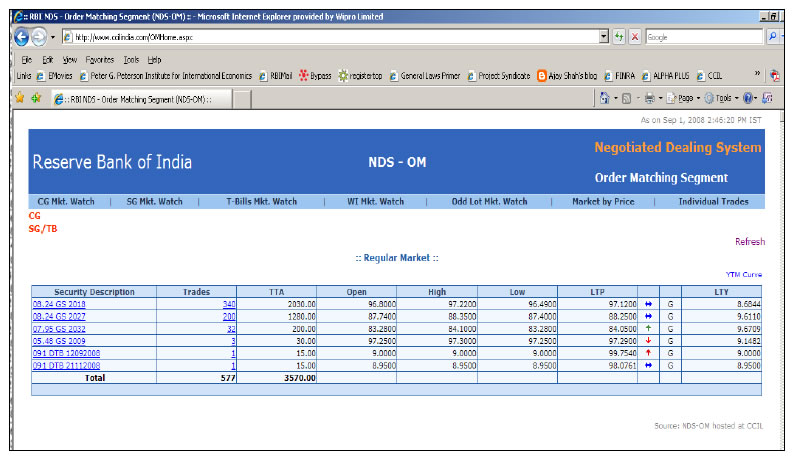
14.2 Price information is vital to any investor intending to either buy or sell G-Secs. Information on traded prices of securities is available on the RBI website http://www.rbi.org.in under the path Home → Financial Markets → Financial Markets Watch → Order Matching Segment of Negotiated Dealing System. This will show a screen containing the details of the latest trades undertaken in the market along with the prices. Additionally, trade information can also be seen on CCIL website http://www.ccilindia.com/OMHome.aspx. On this page, the list of securities and the summary of trades is displayed. The total traded amount (TTA) on that day is shown against each security. Typically, liquid securities are those with the largest amount of TTA. Pricing in these securities is efficient and hence UCBs can choose these securities for their transactions. Since the prices are available on the screen they can invest in these securities at the current prices through their custodians. Participants can thus get near real-time information on traded prices and take informed decisions while buying / selling G-Secs. The screenshots of the above webpage are given below:
NDS-OM Market
The website of the Financial Benchmarks India Private Limited (FBIL), (www.fbil.org.in) is also a right source of price information, especially on securities that are not traded frequently.
Foreign Investment in India
Indian Currency
B) Banknotes
Fifteen languages are appearing in the language panel of banknotes in addition to Hindi prominently displayed in the centre of the note and English on the reverse of the banknote.
Biennial survey on Foreign Collaboration in Indian Industry (FCS)
Some important definitions and concepts
Ans.: An Indian company is called as Foreign Associate if non-resident investor owns at least 10% and no more than 50% of the voting power/equity capital or where non-resident investor and its subsidiary(s) combined own at least 10% but no more than 50% of the voting power/equity capital of an Indian enterprise.
Install the RBI mobile application and get quick access to the latest news!
Scan the QR code to install our app



Page Last Updated on: December 10, 2022


