 IST,
IST,





Content Type:
Indian Currency
D) Soiled, Mutilated and Imperfect Banknotes
The Reserve Bank of India has issued a press release on March 12, 2008, appealing members of public not to use banknotes for making garlands, decorating pandals and places of worship or for showering on personalities in social events, etc. Press Release issued in this regard is available at the following link:
https://rbi.org.in/web/rbi/-/press-releases/respect-your-banknotes-rbi-appeals-to-public-18026.
FAQs on Non-Banking Financial Companies
Credit Rating
Retail Direct Scheme
Investment and Account holdings related queries
Annual Return on Foreign Liabilities and Assets (FLA) under FEMA 1999
Some Useful Definitions
Ans: Any domestic liabilities or assets (even if it is in foreign currency) should not be reported in the FLA return.
Domestic Deposits
III. Advances
Government Securities Market in India – A Primer
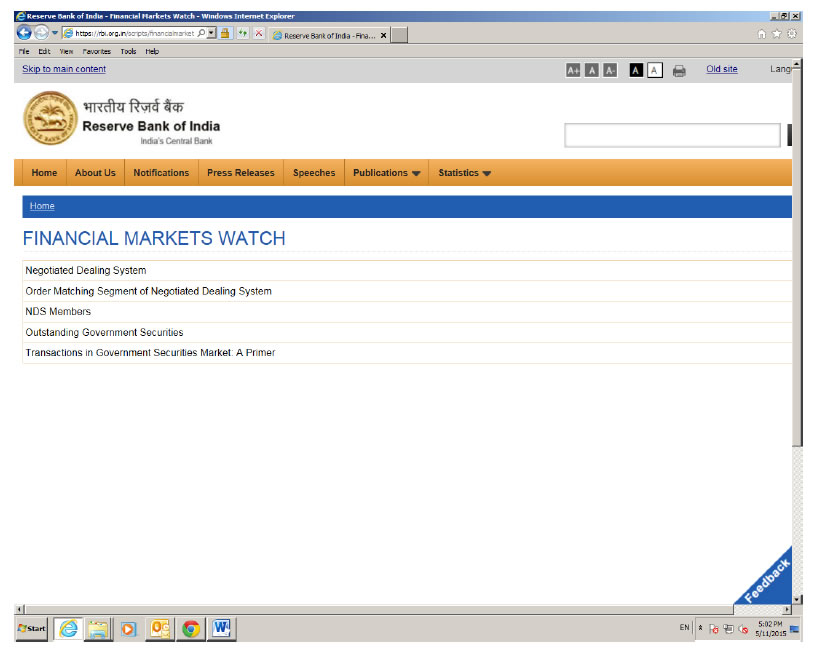
32.1. RBI financial market watch - /en/web/rbi/financial-markets/other-links/financial-market-watch
This site provides links to information on prices of G-Secs on NDS-OM, money market and other information on G-Secs like outstanding stock etc.
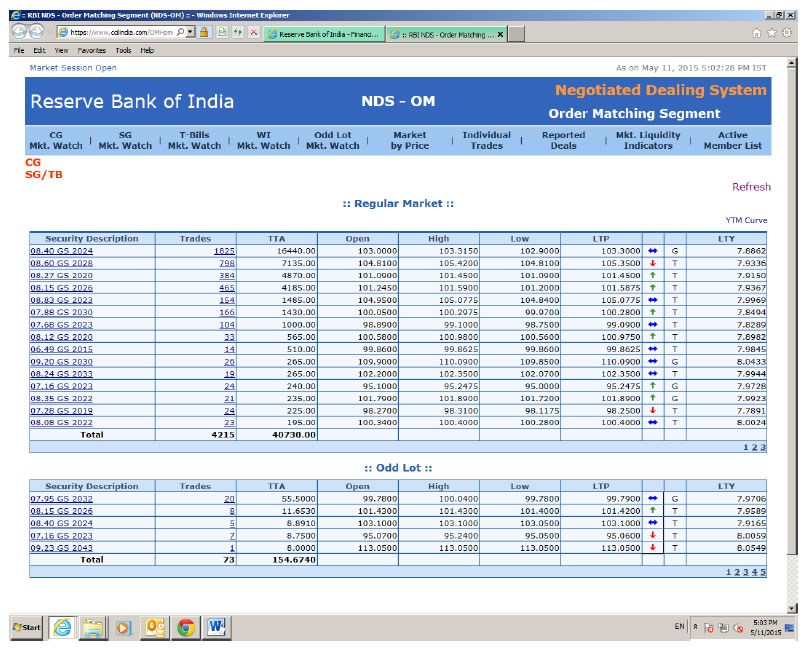
32.2. NDS-OM market watch https://www.ccilindia.com/OMHome.aspx
This site provides real-time information on traded as well as quoted prices of G-Secs, both in Order matching and Reporting segment. In addition, prices of When Issued (WI) (whenever trading takes place) segment are also provided.
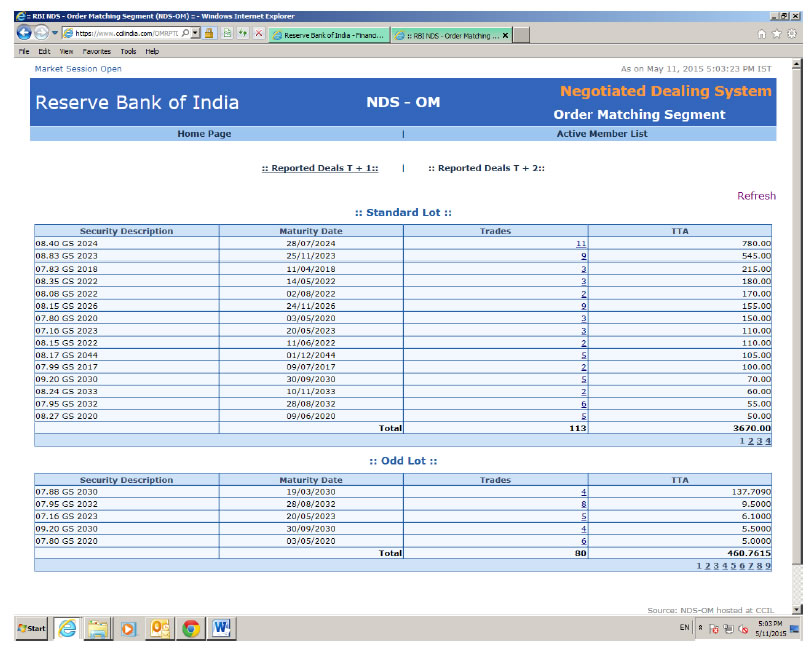
32.3. Reported deals on NDS-OM: https://www.ccilindia.com/OMRPTDeals.aspx
This site provides information on prices of G-Secs in OTC market as reported. One can see chronological traded price levels and quantity in various securities.
32.4 FBIL – www.fbil.org.in
Financial Benchmark India Private Ltd (FBIL) was jointly promoted by Fixed Income Money Market & Derivative Association of India (FIMMDA), Foreign Exchange Dealers’ Association of India (FEDAI) and Indian Banks’ ‘Association (IBA). It was incorporated on 9th December 2014 under the Companies Act 2013. It was recognised by Reserve bank of India as an independent Benchmark administrator on 2nd July 2015.
The company is run by a Board of Directors, assisted by an oversight committee. The main object of the company is to act as the administrators of the Indian interest rate and foreign exchange benchmarks and to introduce and implement policies and procedures to handle the benchmarks. It also will make policies for possible cessation of any benchmark and to follow steps for ensuring orderly transition to the new benchmarks. FBIL will review each benchmark to ensure that the benchmarks accurately represent the economic realities of the interest that it intends to measure. It will take up/consider such other benchmarks as may be required from time to time by periodically assessing the emerging needs of the end -users.
32.5 FIMMDA - http://www.fimmda.org/
This site provides a host of information on market practices for all the fixed income securities including G-Secs. Accessing information from this site requires a valid login and password which are provided by FIMMDA to the eligible entities.
Foreign Investment in India
Indian Currency
D) Soiled, Mutilated and Imperfect Banknotes
Yes. Such banknotes can be exchanged for value.
All you wanted to know about NBFCs
E. Collective Investment Schemes (CIS) and Chit Funds
Retail Direct Scheme
Investment and Account holdings related queries
-
After logging into the Primary Market Retail Direct platform, select the ‘Primary Market’ option beside the Dashboard, at the top of the page.
-
Select a security to bid from the ‘Auction Watch’ and enter the bid amount in the ‘Bid Entry’ window.
-
Individuals can fund their bid either at the time of bidding or at a later time, but before the closure of bidding/subscription window. Bids which are not funded as on the date of submission of bids to RBI will be cancelled.
-
For making payment for the bids, retail clients can use services like UPI (Transfer or Block) and Net Banking to transfer funds to a designated current account using Payment Gateways linked to the Online Portal.
-
Based on the allotment advice received as a part of the auction result, the allotments will be made to the individual investors.
-
In case of full allotment, each bidder will be allocated the entire Face Value for which bids were submitted. In case of partial allotment, a pro-rata allotment will be made to the bidder based on the partial allocation percentage determined in the auction.
For further details on the biding process, you may refer to the User Manual in the Help section of the Retail Direct Portal.
FAQs on Non-Banking Financial Companies
Credit Rating
Annual Return on Foreign Liabilities and Assets (FLA) under FEMA 1999
Some Useful Definitions
Ans: If the reporting Indian company invests in equity and/or participating preference shares of overseas company, under the Overseas Direct Investment Scheme in India, i.e. investment in Joint venture or wholly owned subsidiaries abroad, then it is considered as direct investment abroad of the Indian company.
NOTE: Registration guidelines and section-wise FAQs for further guidance to be file the FLA return are available in the FAQs section of the FLAIR portal (https://flair.rbi.org.in/fla/faces/pages/login.xhtml).
Domestic Deposits
III. Advances
Government Securities Market in India – A Primer
Foreign Investment in India
Indian Currency
D) Soiled, Mutilated and Imperfect Banknotes
All banks are authorized to accept and exchange soiled banknotes for full value. They shall extend the facility of exchange of soiled/mutilated notes to non-customers also.
All branches of commercial banks are authorised to adjudicate mutilated banknotes (which are legal tender) and pay value for these, in terms of the Reserve Bank of India (Note Refund) Rules, 2009 [as amended by Reserve Bank of India (Note Refund) Amendment Rules, 2018].
Small Finance Banks (up to two years from the commencement of their banking business) and Payment Banks may exchange mutilated and imperfect/defective notes at their option.
All you wanted to know about NBFCs
F. Money Circulation/Multi-Level Marketing (MLM)/ Ponzi Schemes/ Unincorporated Bodies (UIBs)
No, Multi-Level Marketing companies, Direct Selling Companies, Online Selling Companies do not fall under the purview of the Reserve Bank. Activities of these companies fall under the regulatory/administrative domain of respective state government. The provisions of the Consumer Protection Act, 2019 and the Consumer Protection (Direct Selling) Rules, 2021 may be referred. The list of regulators and the entities regulated by them are provided in Annex I.
FAQs on Non-Banking Financial Companies
Credit Rating
Retail Direct Scheme
Investment and Account holdings related queries
Domestic Deposits
III. Advances
Install the RBI mobile application and get quick access to the latest news!
Scan the QR code to install our app



Page Last Updated on: December 10, 2022


